Affiliate disclosure: As an Amazon Associate, wellwateractionplan.com earns from qualifying purchases. When you click links on this site and make a purchase, we may earn a commission at no additional cost to you. Read our full affiliate disclosure.
If you rely on a private well, you’re responsible for the safety and quality of your drinking water. That means any treatment system you buy — whether a whole-house filter, a reverse osmosis unit, or a UV disinfection system — needs to do what it claims. Certifications exist to give you an independent, third-party verification that a product meets specific performance standards.
This guide walks through the major certification programs, the key standards they test against, how to verify a product’s claims, and where the limits of certification lie. The goal isn’t to make you an expert in testing protocols, but to help you ask the right questions and avoid costly mistakes.
- Look for NSF/ANSI, WQA Gold Seal, or IAPMO marks tied to specific standard numbers (42, 53, 58, 55, 401) — not just generic “certified” language.
- Match the standard to your contaminant: 42 for taste/odor/particulates, 53 for health contaminants (lead, arsenic, VOCs, cysts), 58 for RO systems, 55 Class A for UV disinfection of contaminated well water.
- Verify the exact model in the certifier’s online directory; confirm the contaminant list, rated capacity, and test conditions match your needs.
- Certification validates lab performance under controlled conditions — real-world performance depends on your water chemistry, flow rate, maintenance, and proper installation.
- For complex well water problems (multiple contaminants, high flow, code requirements), hire a certified water specialist or licensed plumber to design and install the system.
Why Certifications Matter for Well Water Systems
Unlike municipal water, which is regulated and monitored by public utilities, private well water has no mandatory federal oversight [1]. Contaminants — bacteria, nitrates, arsenic, volatile organic compounds, hardness minerals, and more — vary widely by geology, land use, and well construction. A treatment system that works for one well may be useless for another.
Certifications provide a baseline: they confirm that a product, as manufactured, can reduce specific contaminants under defined laboratory conditions. They don’t guarantee the system will work perfectly in your home — installation, maintenance, water chemistry, and flow rates all affect real-world performance — but they do weed out products that haven’t been independently tested at all.
For homeowners, the practical value is comparison shopping. If two sediment filters both claim to remove particles down to 5 microns, but only one carries an NSF/ANSI 42 certification for particulate reduction, you have a verifiable reason to prefer that one. The same logic applies to lead, cysts, VOCs, and other health-related contaminants [2].
Key Certification Bodies and What They Cover
In North America, three organizations dominate residential water treatment certification: NSF International (often referenced as NSF), the Water Quality Association (WQA), and IAPMO R&T (formerly the International Association of Plumbing and Mechanical Officials). All three are accredited by the American National Standards Institute (ANSI) and the Standards Council of Canada (SCC) to certify products to NSF/ANSI standards.
NSF International developed many of the foundational standards (NSF/ANSI 42, 53, 58, 401, etc.) and operates its own certification program. Products that pass carry the NSF mark. WQA runs the Gold Seal program, testing to the same NSF/ANSI standards; certified products display the WQA Gold Seal. IAPMO R&T also certifies to NSF/ANSI standards and uses the UPC or Water Quality marks.
From a homeowner’s perspective, these marks are functionally equivalent — they all mean the product was tested by an accredited lab to the same consensus standard [3]. What matters is the specific standard number cited (e.g., NSF/ANSI 53 for lead reduction), not which organization issued the mark. A product certified by WQA to NSF/ANSI 53 meets the same test criteria as one certified by NSF to NSF/ANSI 53.
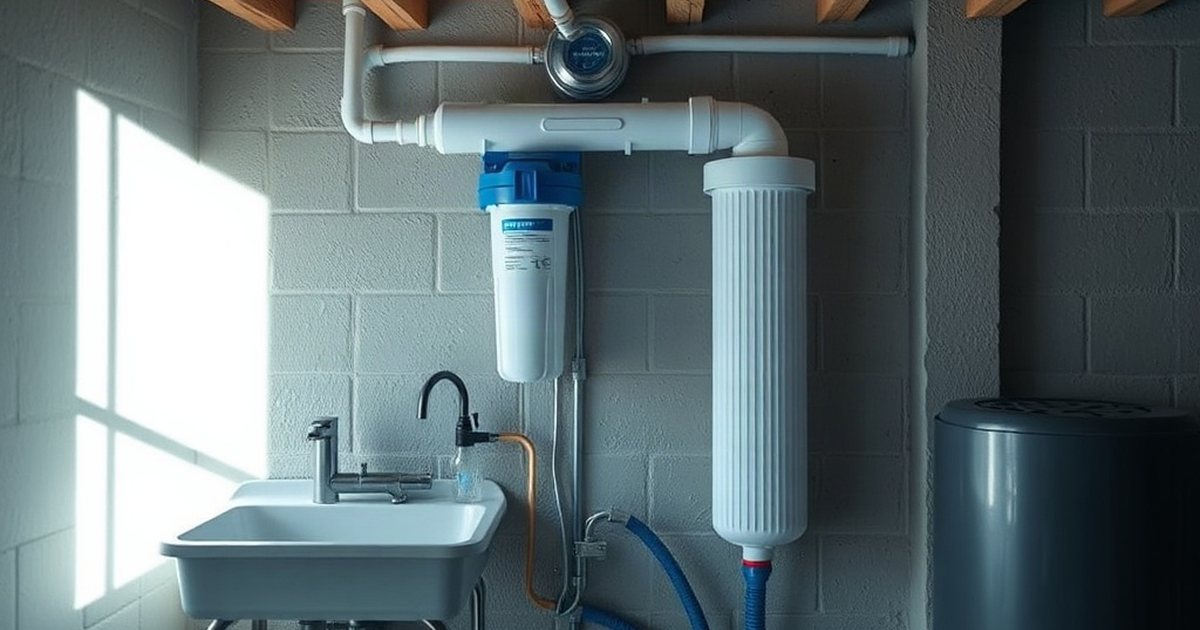
Common NSF/ANSI Standards for Residential Treatment
NSF/ANSI 42 covers aesthetic effects — taste, odor, chlorine, and particulate reduction. It’s the most common certification for carbon filters, sediment filters, and refrigerator filters. It does not address health-related contaminants.

NSF/ANSI 53 covers health-related contaminants — lead, arsenic, VOCs, MTBE, cysts (Cryptosporidium, Giardia), and others. A product certified to NSF/ANSI 53 must specify which contaminants it reduces and to what level. Look for the contaminant-specific claim on the certification listing, not just the standard number.
NSF/ANSI 58 applies to reverse osmosis (RO) systems. It includes requirements for total dissolved solids (TDS) reduction, as well as specific contaminant claims (lead, arsenic, nitrate, etc.) that mirror NSF/ANSI 53. RO systems often carry dual certification to both 58 and 53.
NSF/ANSI 401 addresses emerging contaminants — certain pharmaceuticals, pesticides, and flame retardants not yet regulated by the EPA. Certification is voluntary and the contaminant list is narrower than 53, but it signals additional testing.
NSF/ANSI 55 covers ultraviolet (UV) microbiological water treatment systems. Class A systems are rated for disinfection of contaminated water (including cysts); Class B are for supplemental treatment of already microbiologically safe water. For well water with known bacterial issues, Class A is the relevant category.
NSF/ANSI 61 and 372 address material safety — ensuring components in contact with drinking water don’t leach harmful levels of lead or other substances. Most certified treatment products also carry these, but they’re not performance standards for contaminant removal.
How to Verify a Product’s Certification Claims
Manufacturers sometimes imply broader certification than they hold. A product might be certified to NSF/ANSI 42 for chlorine reduction, but marketing language suggests it also removes lead. The only reliable way to check is the certifier’s online directory.
NSF’s directory (info.nsf.org/Certified/DWTU), WQA’s product search (wqa.org/find-products), and IAPMO’s listing (plumbingdirectory.iapmo.org) let you search by brand, model, or standard. The listing will show exactly which contaminants are certified, the rated capacity (gallons or liters), and the test conditions (pH, temperature, flow rate).
Pay attention to the rated capacity. A filter certified for lead reduction at 1,000 gallons may not perform the same at 1,500 gallons. If your household uses more water than the rated capacity between filter changes, the certification no longer applies. Also note the test pH — many standards test at pH 6.5 and 8.5; if your well water is outside that range, performance may differ.

Keep a copy of the certification listing (screenshot or PDF) for your records. If you later need to troubleshoot performance or file a warranty claim, it’s your proof of what the product was verified to do.
Red Flags and Marketing Claims to Question
Phrases like “tested to NSF standards” or “meets NSF/ANSI 53 requirements” without a certification mark or directory listing are not the same as certification. They usually mean the manufacturer did internal testing, not that an accredited third party verified it.
Broad claims like “removes 99.9% of contaminants” are meaningless without specifying which contaminants, at what concentration, under what conditions. Legitimate certifications list each contaminant individually with a reduction percentage or concentration limit.
Some products carry a certification for one component (e.g., the carbon block) but not the full system as sold. The directory listing should reflect the exact model number you’re buying. If the model number doesn’t match, ask the seller for clarification.
Be wary of a bare “certified” claim that names no standard number at all, and check the scope as well as the number, because coverage is usually narrower than the contaminant name suggests. PFAS (per- and polyfluoroalkyl substances) is the clearest example [4]. NSF/ANSI 53 and NSF/ANSI 58 do carry PFAS reduction claims, but only for a named subset. The standards were updated in 2019 to add test methods for PFOA and PFOS to both drinking water treatment units and reverse osmosis systems [5], and the 2022 versions added five further compounds (PFHxS, PFNA, PFHpA, PFBS and PFDA) and introduced a combined “Total PFAS” reduction claim covering all seven [6]. Seven compounds is a narrow slice of a family numbering in the thousands, so a system certified for “Total PFAS” has been tested against those seven and nothing else. Ask which standard (53 or 58) and which compounds appear on the directory listing for your exact model, rather than accepting a bare “removes PFAS” claim on the packaging.
Cost Considerations and When to Involve a Professional
Certified systems cost more than uncertified alternatives — typically 20–50% more for comparable capacity. That premium pays for the testing, auditing, and ongoing compliance. For health-related contaminants (lead, arsenic, bacteria), the extra cost is usually justified. For aesthetic issues (taste, odor, sediment), a non-certified filter may be acceptable if you’re comfortable replacing it more often.
Installation costs vary widely. Point-of-use systems (under-sink RO, countertop filters) often cost $150–$600 for the unit plus $200–$500 for professional installation if you don’t DIY. Whole-house systems (carbon tanks, water softeners, UV) run $1,000–$4,000+ installed. Certification doesn’t affect installation cost, but it does affect long-term confidence.

Ongoing costs include replacement cartridges, UV lamps, RO membranes, and media. Certified replacement parts are required to maintain the system’s certified performance. Using off-brand cartridges voids the certification claim, even if the housing is the same.
A water treatment professional (certified water specialist, licensed plumber with water treatment experience) adds value when: your well water has multiple or unusual contaminants; you need a whole-house system sized correctly; local codes require permits or licensed installation; or you want a maintenance plan. They can also interpret your water test results and match them to the right certified technology — something a certification mark alone cannot do.
FAQ
Does a certification guarantee the system will work in my home?
No. Certification confirms the product meets performance standards in a lab under defined conditions. Your well’s water chemistry, pressure, temperature, and how you maintain the system all affect actual results. Regular water testing after installation is the only way to verify ongoing performance.
Can I use a non-certified filter if it’s cheaper?
For aesthetic issues like chlorine taste or sediment, a non-certified filter may be fine if you monitor it closely. For health-related contaminants — lead, arsenic, bacteria, nitrates — an uncertified product is a gamble. The cost difference rarely justifies the risk.
What if my well has a contaminant with no NSF/ANSI standard?
Some emerging contaminants (certain PFAS compounds, pharmaceuticals) lack formal standards. In those cases, look for NSF/ANSI 401 certification if applicable, or ask the manufacturer for independent lab data using EPA or ISO methods. A water treatment professional can help evaluate limited data.
Do I need to replace cartridges with the exact brand to keep certification valid?
Yes. Certification applies to the system as tested, including specific replacement parts. Using off-brand cartridges means the system no longer matches the certified configuration, even if the housing fits.
Is a whole-house system always better than point-of-use?
Not necessarily. Whole-house treats all water (bathing, laundry, irrigation) but is expensive and may not address all contaminants effectively. Point-of-use (under-sink RO, dedicated faucet) gives higher-quality drinking water at lower cost. Many homes use both: whole-house for sediment/iron/hardness, point-of-use for drinking water contaminants.
This article provides general guidance on certification programs and standards; it does not replace professional water testing or system design. Well water quality varies widely — have your water tested by a state-certified laboratory before purchasing any treatment system. For health-related contaminants, complex water chemistry, or code-governed installations, consult a licensed water treatment professional or certified water specialist.
References
- Private Drinking Water Wells. U.S. Environmental Protection Agency
- Basic Information about Lead in Drinking Water. U.S. Environmental Protection Agency
- Certification of Laboratories that Analyze Drinking Water Samples. U.S. Environmental Protection Agency
- Per- and Polyfluoroalkyl Substances (PFAS). U.S. Environmental Protection Agency
- NSF standards add PFOA and PFOS reduction claims requirements. National Ground Water Association
- NSF Joint Committee adds additional PFAS compounds to NSF/ANSI 53 & NSF/ANSI 58. WaterWorld
These statements have not been evaluated by the Food and Drug Administration. This information is not intended to diagnose, treat, cure, or prevent any disease. Content is for informational purposes only and is not medical advice; consult a qualified healthcare provider before starting any supplement. As an Amazon Associate we earn from qualifying purchases.
